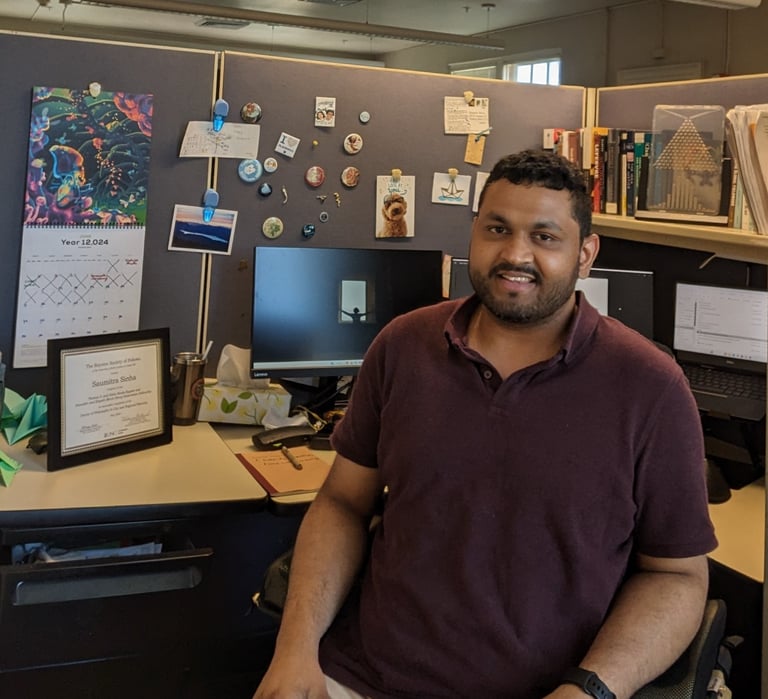
Saumitra Sinha, Ph.D.
I am Saumitra (pronounced Sh-ohm-it-roh), also known as Shomi. I am an interdisciplinary researcher and urban planner focusing on improving decision-making for allocating scarce resources and addressing interconnected risks in urban areas of the Global South. My work is anchored around Water, Sanitation, and Hygiene (WASH) policy, employing mixed-methods, quantitative, and qualitative research approaches. My insights are shaped by extensive professional and field experience in India and Malawi.
In my current position as a Postdoctoral Research Associate at the Pulte Institute for Global Development within the Keough School of Global Affairs at the University of Notre Dame, I am part of an interdisciplinary team working on the project, "Innovative Solutions to Interlinked Water Insecurity, Poverty, and Poor Health in Africa's Urban Slums." I played a key role in developing the conceptual framework and mixed-methods research design for the project. In Blantyre, Malawi, I co-conducted interviews with residents in informal settlements and stakeholders involved in water provision to analyze how WASH decisions influence their daily trade-offs and the impact of institutional constraints on these choices. My current responsibilities include leading a large-scale household survey that will enable a comprehensive analysis of the interconnected issues of poverty, health, WASH choices, water quality, and the spatial characteristics of neighborhoods.
My doctoral dissertation at the University of North Carolina at Chapel Hill (UNC), titled "Muddling Through to Uphold the Right to Water? An Examination of Delhi’s Free Water Policy," addressed the challenge of reassessing public spending in the water sector of Global South metropolises amid resource scarcity. The research introduced a novel application of discrete choice experiments to quantify community preferences regarding the reform of existing water subsidy policies. Specifically, the study measured preferences for changing the subsidy eligibility criteria and examined the public's perceptions of the trade-offs involved in reallocating water subsidy funds to improve water services. The study was complemented by a qualitative analysis of informal institutions that govern water sharing and payment arrangements among households with shared water connections.
My interdisciplinary research was recognized with the UNC Royster Society of Fellows Dissertation Completion Fellowship. A chapter from my dissertation was awarded Best Student Paper on international planning at the 2023 Association of Collegiate Schools of Planning (ACSP) conference (Global Planning Educators Interest Group).
As a Teaching Assistant (TA) at UNC, I followed an engaged learning pedagogy for both technical and substantive courses. I developed applied teaching cases on congestion pricing, re-zoning, and urban stormwater runoff for Microeconomics for Planning and Policy (PLAN 710), and led guided labs on statistics and regression analysis for Planning Methods (PLAN 720). I have also served as a TA for a class on WASH policy in developing countries (ENVR/PLAN 685) at UNC, as well as a GIS class as a master's student at Cornell. In 2021, I was honored to be selected as the best TA by planning master's students at UNC.
I also hold a Master's degree in Regional Planning from Cornell University and a Bachelor of Architecture from the School of Planning and Architecture in New Delhi. My prior professional research included qualitative and spatial analysis on floodplain management in Kolkata and Upstate New York, as well as research support for the Tata-Cornell Institute for Agriculture and Nutrition through remote sensing and spatial analysis in India.